Book A Call Now

Visceral Fat vs The Fat You Can Pinch: What Really Matters
The soft fat you can pinch isn't usually the dangerous one. Here's what the science says about visceral fat — and what actually helps.
For years, I’d stand in front of the mirror and pinch the bit of my tummy that wouldn’t budge. That soft little roll above my waistband — that, I was convinced, was the enemy. Then I learned something that changed how I think about my body completely: the fat I could squeeze between my fingers wasn’t the one quietly causing problems. The fat that matters most sits much deeper, where you can’t pinch it at all. And once you understand the difference, the whole “how do I lose weight” conversation starts looking very different.
Two Kinds of Belly Fat (and Why It Matters)
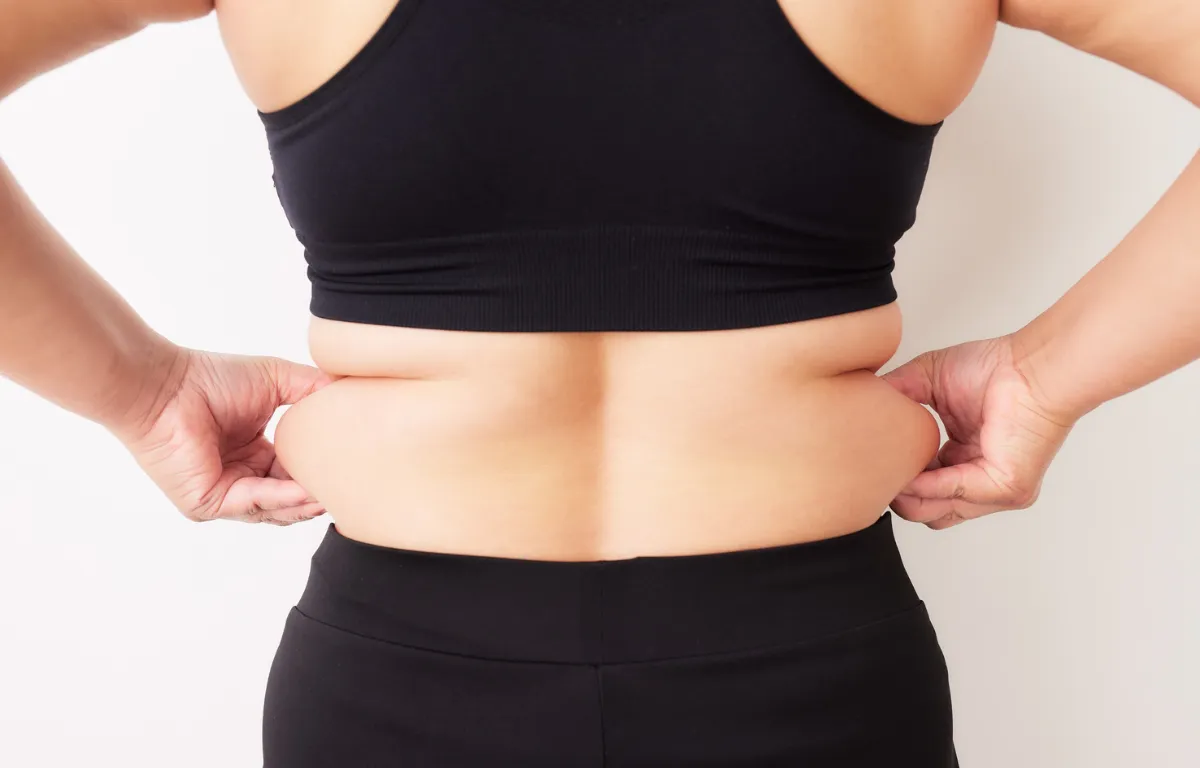
When most of us say “belly fat,” we picture the squishy layer just under the skin. Doctors call this subcutaneous fat. It’s the bit you can grab between your fingers. It can be frustrating cosmetically, but on its own, it isn’t the real health villain.
The fat that does the most damage sits deeper, wrapped around your liver, intestines, pancreas, and other organs. That’s visceral fat. You can’t pinch it. You can’t always see it. Some people who look slim on the outside carry quite a lot of it on the inside — researchers sometimes call this pattern “thin outside, fat inside” (or TOFI in the scientific literature). It pushes the belly forward and makes it feel firm rather than soft, like a small, taut drum rather than a cushion.
If you can pinch more than about an inch of skin around your belly, you’re probably looking at subcutaneous fat. If your belly is firm and round even when you relax — that’s the visceral fat talking.
Visceral Fat Is Almost Like an Extra Organ
Here’s the bit of science that genuinely surprised me when I first read it. Visceral fat isn’t passive storage. It behaves more like a busy little organ that’s been quietly switched on without your permission.
When there’s too much of it, visceral fat starts releasing chemical messengers called cytokines — things with technical names like TNF-α and interleukin-6. Think of these as tiny inflammatory signals being constantly broadcast through your bloodstream. The result is a low-grade, body-wide inflammation that doesn’t feel like anything in particular but, over months and years, makes your cells less responsive to insulin, raises your LDL cholesterol, and stiffens your blood vessels.[1][2]
That’s why visceral fat is so strongly linked to heart disease, type 2 diabetes, and high blood pressure — not because it’s “extra weight,” but because it’s constantly nudging your internal chemistry out of balance.
The good news in all of this? You can’t see visceral fat shrinking the way you can watch a squishy roll shrink in the mirror, but on the inside, the inflammation calms down surprisingly quickly when you give your body the right inputs.
The Statistic That Should Stop Us All in Our Tracks
I’m not one for scare statistics, but this one is worth sitting with for a moment.
A large U.S. study published in the Annals of Internal Medicine tracked more than 15,000 adults over many years. The headline finding: men of “normal” BMI who carried a lot of visceral fat around the middle had an 87% higher risk of dying from any cause compared with men of the same BMI who didn’t carry that central fat. Women with the same pattern had a 48% higher mortality risk than peers with similar BMI but no central obesity — and, strikingly, an even higher risk than women who were technically classified as obese by BMI alone.[3]
Read that again. People who looked fine on the scale, who’d never be told to lose weight by a GP, were quietly carrying more risk than people in larger bodies who didn’t have the central pattern.
That’s why I’ve stopped trusting the scale on its own. The tape measure around your waist tells you a different — and arguably more honest — story.
The Myth I Had to Unlearn
For most of my adult life, I believed the goal was to shrink the part I could pinch. That belief sent me down some bumpy roads — extreme diets, punishing workouts, the cabbage-soup years we don’t talk about. The reframe that genuinely helped was this: my waistline matters more than my weight, and visceral fat is the one quietly pulling the strings behind the scenes.
Here’s the most hopeful part of all the research I read: visceral fat tends to respond faster to gentle, consistent lifestyle changes than the stubborn subcutaneous layer does. Studies show that even modest improvements in sleep, movement, and nutrition can start shrinking visceral fat within weeks, with measurable drops in blood pressure, blood sugar, and cholesterol following close behind.[1]
You may not see your jeans get looser straight away. But on the inside, the inflammation is already calming, even if the mirror is slower to catch up. That’s a really important thing to remember when motivation dips in week three.
What Actually Helps (No Punishment Required)
You don’t need a militant plan. The basics still win, and the science agrees:
- Walk most days. Even 30 minutes of brisk walking shifts visceral fat over a few months.
- Strength work twice a week. Muscle is metabolically active tissue — it changes the chemistry of your whole body.
- Real food, most of the time. Less ultra-processed, more colour. Boring advice; remarkably effective.
- Sleep like it matters. Because it does. Poor sleep spikes cortisol, and cortisol parks fat right where you don’t want it — around your middle.
- Soften your stress. Chronic stress and visceral fat are old friends. Anything that helps you breathe deeper helps.
I’ve also added a few drops of pHix to my morning drink. It’s a matured hop extract I’ve come to lean on as a small daily habit — designed to support natural fat metabolism without caffeine or stimulants. It’s not a magic wand, and I’d never pretend it was. It’s just one steady thing alongside the rest. The published research on the active compound looks specifically at visceral fat over an 8–12 week window, which is part of why I trust it as a long-game tool rather than a quick fix.

Closing
If you’ve spent years chasing the bit you can pinch, please be kind to yourself. You were aiming at the wrong target — that’s not a failure, that’s just information you didn’t have. Start measuring your waist alongside the scale. Sleep a little earlier. Walk a little more. And if you’d like to try pHix as part of your routine, I’d love to send you the short version of my own journey — pop your email into the list on the site and I’ll share what’s worked for me, no hype, no pressure.
Disclaimer
These statements have not been evaluated by the FDA. This product is not intended to diagnose, treat, cure, or prevent any disease. Always consult your healthcare provider before starting any new supplement.
References
[1] Longo, M. et al. (2019). Adipose tissue inflammation and metabolic dysfunction in obesity. American Journal of Physiology — Cell Physiology. Read
[2] Cleveland Clinic. Visceral Fat: What It Is and How It Affects You. Read
[3] Sahakyan, K. R. et al. (2015). Normal-Weight Central Obesity: Implications for Total and Cardiovascular Mortality. Annals of Internal Medicine, NHANES III cohort (15,184 adults). Read