Book A Call Now

Stress and Belly Fat: The Cortisol Cycle Nobody Warned You About
Discover how chronic stress triggers cortisol to store fat around your belly — and the practical daily steps that can break the cycle for good.
There was a season in my life when I was doing everything right. Watching what I ate, moving my body, drinking my water — and still, my jeans were tighter than they’d ever been around the middle. I remember standing in front of the mirror, genuinely baffled. And a little bit defeated, honestly. I was doing “the thing”, so why wasn’t the thing working?
It wasn’t until I started digging into the science that I found the missing piece of the puzzle: stress. Not dramatic, obvious stress. The low-hum, relentless kind that doesn’t announce itself — it just quietly rewires your body, month after month. Here’s what I found, and why I think it’s the conversation nobody in the wellness space is having clearly enough.
Why Stress Sends Fat Straight to Your Middle
Let me walk you through what’s actually happening in your body — because once you understand the mechanism, everything starts to make sense.
When you’re under sustained pressure — a packed schedule, a difficult relationship, financial worry, even just the constant mental load of running a home and a life — your brain sounds an internal alarm. Your hypothalamus (the small control centre deep in your brain) fires off a chain of signals that travel down through your pituitary gland all the way to your adrenal glands, two small glands sitting just above your kidneys. The end result? A flood of a hormone called cortisol.[1]
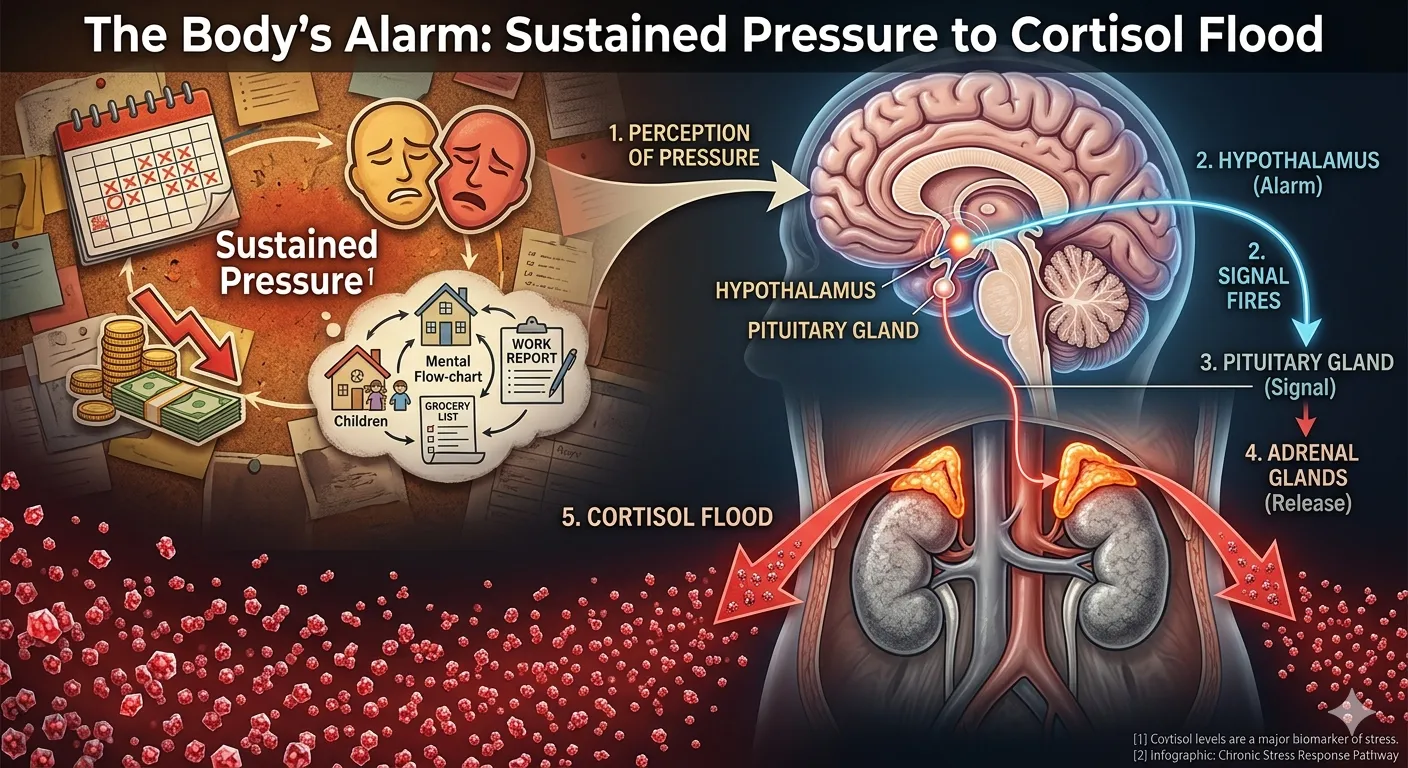
Cortisol is your primary stress hormone. In short bursts, it’s genuinely useful — it sharpens your focus, frees up energy, and helps you rise to a challenge. The problem begins when the challenge never really goes away. And let’s be honest: modern life doesn’t offer a lot of clean endings.
When cortisol stays elevated for weeks or months at a time, something very specific starts happening in your fat tissue. Deep abdominal fat — the kind that wraps around your organs, not just the kind you can pinch — has a higher density of cortisol receptors than fat anywhere else in the body.[1] Picture a docking station. Cortisol goes looking for somewhere to redirect excess fat, and visceral fat (that’s the technical term for organ-surrounding fat) essentially rolls out the biggest welcome mat.
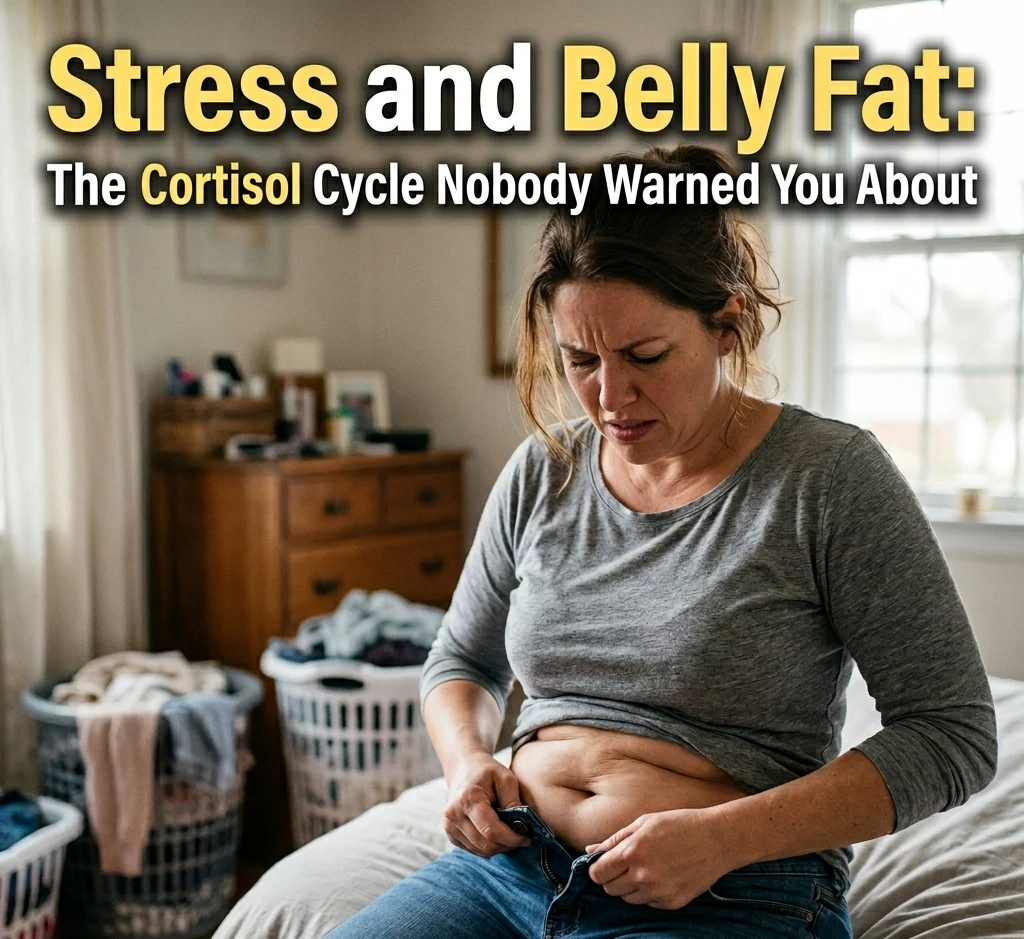
On top of that, chronically elevated cortisol signals your body to move fat away from your arms and legs and towards your midsection.[1] So even if your overall weight hasn’t shifted dramatically, the distribution changes. Your waist measurement climbs. Your jeans tell the story before the scale does — and that’s not your imagination.
The Numbers Are Hard to Ignore
I want to share a few statistics, because sometimes seeing the scale of a problem is what finally makes it feel real.
A major review published in the peer-reviewed journal Clinical Obesity in 2024 — a comprehensive analysis by researchers at Erasmus University Medical Centre — pulled together the growing body of evidence on stress and obesity. Their meta-analysis found a significant positive link between perceived stress levels and larger waist circumference, higher BMI, and elevated blood triglycerides.[1]
Globally, the picture is sobering. A 2022 Lancet study found that more than one billion people were living with obesity worldwide.[1] And the World Health Organisation has described chronic stress as the “Health Epidemic of the 21st Century.”[1] That phrase doesn’t get nearly enough airtime.
One detail from the research that I found quietly stunning: scientists can now measure how much cortisol a person has been exposed to over months by analysing a small sample of scalp hair. Because hair grows around one centimetre per month, a longer strand is essentially a timeline of your stress load. Studies consistently show that people with higher long-term hair cortisol levels tend to have larger waist circumferences — and the association holds across diverse populations.[1]
In plain English: if your body has been bathing in stress hormones for an extended stretch, your belly is often the first visible place that shows up.
The Myth I Need to Clear Up Right Now
You may have seen the phrase “cortisol belly” flooding your social media feed lately — paired with supplements claiming to “block cortisol” and dissolve your midsection. I want to gently but firmly push back on this, because the science is considerably more nuanced than those viral posts suggest.
Here’s the honest truth: cortisol on its own doesn’t manufacture belly fat out of thin air.[2] It’s not a simple fat-storage switch you can flip off with a pill. What cortisol does do — when it’s chronically elevated — is influence where your body chooses to deposit fat, interfere with the hormones that should make you feel satisfied after eating, and make high-calorie comfort food feel practically magnetic. The effect is real, but it’s woven through your entire lifestyle, not caused by one hormone in isolation.
This distinction matters enormously. If cortisol is the sole villain in your story, it’s tempting to buy a cortisol-blocking supplement and call it done. But there is currently no good evidence that over-the-counter cortisol blockers produce meaningful, lasting fat reduction in otherwise healthy people.[2] What they do do is take the focus off the things that actually work — sleep, movement, stress management, and consistent daily habits.
Cortisol is a real and important player in the belly fat story. It’s just not the only one. And understanding that is genuinely freeing, because it means there are multiple real levers you can pull.
The Hunger Trap Nobody Told Me About
Here’s the part that personally surprised me the most, and that I think explains so much about why high-stress periods are so hard to navigate.
Cortisol doesn’t just tell your body where to store fat — it also directly disrupts your appetite signals in a very targeted way.
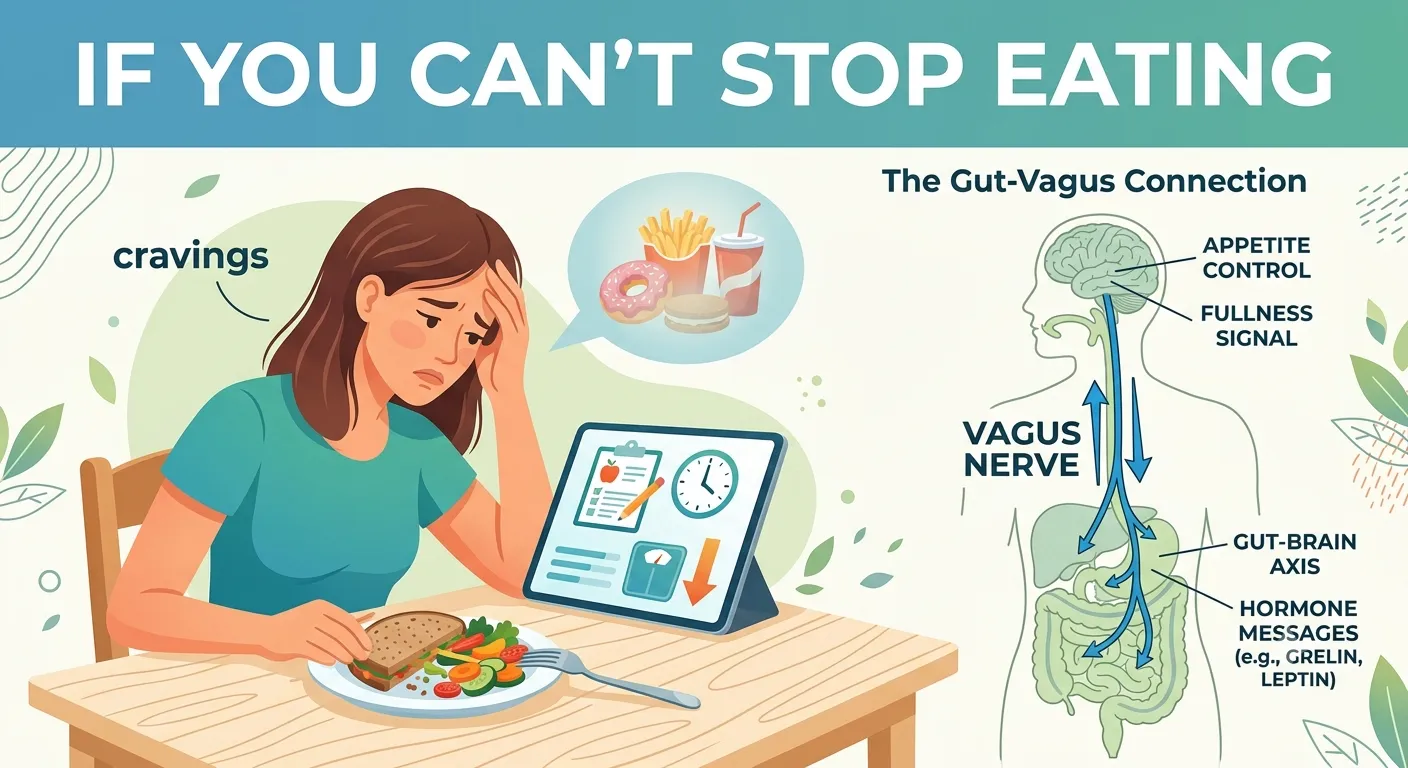
Under chronic stress, cortisol interacts with two key hunger hormones: leptin and ghrelin. Leptin is your satiety hormone — the one that signals to your brain that you’ve had enough to eat. Ghrelin is the one that says find food, now. When cortisol is persistently elevated, research suggests it can suppress leptin and push ghrelin upward — which means you feel less satisfied after meals and more urgently hungry in between them.[1]
And here’s where it gets even more interesting: the hunger that chronic stress tends to trigger isn’t general hunger. Research shows it’s disproportionately aimed at high-fat, high-sugar foods — what we often call comfort eating.[1] And this isn’t a character flaw or a lack of discipline. It is a biological signal, shaped by millions of years of evolution telling your body to stock up on energy-dense fuel when times are hard.
So picture a genuinely difficult week: your body is quietly redistributing fat toward your middle, your hunger hormones are out of calibration, and you’re craving things that feed the cycle further. No wonder dieting during an already-stressful period feels nearly impossible. Your own biology is working against your good intentions — and it has nothing to do with willpower.
Understanding this changed how I approach those harder stretches. Rather than white-knuckling through cravings while exhausted, I started asking a different question: what does my nervous system actually need right now?
The Loop That Keeps It Going
Here’s the part of the cortisol story that I think is the most important — and the least talked about.
The relationship between stress and belly fat doesn’t only go in one direction. It’s a loop. Research shows that having more visceral fat can itself generate low-grade inflammation and biological stress within the body, which in turn contributes to further cortisol production.[1] The belly fat that stress helped create can literally help sustain the conditions that created it.
There’s another layer too. Strong evidence shows that weight stigma — the very real social pressure and internal criticism that many of us carry around our bodies — creates measurable psychological stress.[1] Which means the shame you might feel about your belly can actively contribute to the biological processes that maintain it.
I say this not to make anyone feel hopeless. I say it because once you see the loop, you can start to interrupt it. It’s also why I’ve learnt — slowly, imperfectly — to be gentler with myself on the harder weeks rather than harsher. The old instinct was shame, restrict more, push harder. But if shame triggers cortisol, and cortisol contributes to belly fat, then self-criticism is quite literally working against you.
Self-compassion isn’t just a soft feel-good idea. In the context of the stress and belly fat connection, it may be one of the most practically useful things you can practise.
What Actually Helps — What I Do on High-Stress Weeks
Here’s the practical part. And I want to be honest with you: this isn’t a five-step formula that solves everything overnight. These are habits that, applied consistently over time, genuinely support your body’s stress response. I use all of them. I notice the difference when I skip them.
- Protect your sleep above almost everything else. Research is consistent: 7–9 hours of good sleep is one of the most powerful tools for keeping cortisol in check. Even one poor night has been directly linked to elevated cortisol the following day.[3] On high-stress weeks, sleep is the last thing I compromise on.
- Move, but don’t overdo it. Moderate exercise — a walk, a swim, cycling at a comfortable pace — has been shown to reduce cortisol over time. But heavy, excessive high-intensity training can spike it further.[3] When I’m already stretched, I swap the intense sessions for a longer, gentler walk. It’s not laziness; it’s strategy.
- Breathe deliberately, even for ten minutes. Slow, intentional breathing activates your parasympathetic nervous system — your body’s “rest and digest” mode, which is the biological counterbalance to cortisol’s effects.[3] Four seconds in, six seconds out. That’s genuinely all it takes to start shifting the dial.
- Eat in favour of calm. Leafy greens like spinach and kale are rich in magnesium, which plays a role in cortisol regulation. Omega-3 fatty acids from oily fish reduce inflammation. Berries and their antioxidant compounds help counteract oxidative stress.[4]
- Get outside, even briefly. Research on time spent in green spaces consistently shows reductions in cortisol levels. Twenty minutes in a garden or park counts.[4]
Part of my own daily routine includes pHix drops in my morning drink. The matured hop extract in pHix is designed to support the parasympathetic nervous system — the very system that counterbalances the effects of cortisol. It’s one consistent daily habit that helps me stay in better balance, alongside everything else on this list.

If there’s one thing I hope you take from this post, it’s that stubborn belly fat isn’t a failure of willpower. For many of us, it’s a signal from a nervous system that’s been running in overdrive for too long. That’s changeable — not through restriction and punishment, but through genuinely giving your body the conditions it needs to regulate itself.
I share more of this kind of content on my email list — the stuff that doesn’t fit into a caption, where we can really sit with the science and what it means for everyday life. You’re warmly invited. And if you’d like to try pHix as part of your daily routine, you’ll find it at trienics.co.uk.
Come back and tell me what resonated. I read every single message.
These statements have not been evaluated by the FDA. This product is not intended to diagnose, treat, cure, or prevent any disease. Always consult your healthcare provider before starting any new supplement.
References
- Lengton R, Schoenmakers M, Penninx BWJH, Boon MR, van Rossum EFC. Glucocorticoids and HPA axis regulation in the stress–obesity connection: A comprehensive overview of biological, physiological and behavioural dimensions. Clin Obes. 2025 Apr;15(2):e12725. https://pmc.ncbi.nlm.nih.gov/articles/PMC11907100/
- The Conversation. The ‘cortisol belly’ myth: when diet culture is rebranded as ‘wellness’. https://theconversation.com/the-cortisol-belly-myth…
- Cleveland Clinic. Tips to Reduce Cortisol Levels and Dial Down Stress. https://health.clevelandclinic.org/…
- Healthline. 11 Natural Ways to Lower Your Cortisol Levels. https://www.healthline.com/nutrition/ways-to-lower-cortisol