Book A Call Now

Sleep Is a Fat-Loss Tool — Here’s What Helps Tonight
Struggling to shift stubborn fat despite doing everything right? Science says sleep matters as much as diet. Here’s what’s really going on — and 5 fixes for tonight.
A few years ago, if you’d asked me how I was doing, I’d have said “tired but fine” — and meant it as a compliment to myself. Five, maybe six hours a night, a strong coffee, and off I went. I was eating well, moving more, doing everything I thought mattered for my body. And yet the scale barely budged, my clothes felt the same, and I felt permanently on edge. It took me embarrassingly long to connect the dots. Here’s the “huh, I had no idea” moment that changed things for me: in one well-known study, people on the exact same calorie-controlled diet lost 55% less body fat when they were sleep-deprived.[1] Same food. Same effort. Wildly different result. Sleep isn’t the boring bit at the end of the day — it might be one of the most underrated tools we have.
Your Body’s Night Shift: What’s Actually Happening While You Sleep
Here’s the plain-English version of what goes on overnight. Your body runs on a handful of hormones that quietly tell you when to eat, when to stop, and how to handle stress. Two of the big players are leptin and ghrelin. Think of leptin as your “I’m satisfied, thanks” signal, and ghrelin as your “feed me” signal. Normally, leptin rises while you sleep, which helps keep your appetite in check overnight and into the next morning.
When sleep gets cut short, that balance tips the wrong way: leptin drops, ghrelin rises, and hunger — especially for high-carb, high-fat foods — goes up the very next day.[2] A 2025 review of multiple studies confirmed this pattern holds across age groups and sleep-loss scenarios, linking short sleep duration to higher BMI through exactly this hormone disruption.[3]
On top of that, short sleep raises evening cortisol (your main stress hormone) and reduces insulin sensitivity — meaning your body becomes less efficient at processing the food you eat and more inclined to store it.[2] None of this is about willpower. It’s biochemistry working against you while you’re simply trying to get through a busy week on less rest. Once I understood that the “why can’t I stick to this” feeling had a hormonal explanation, I stopped blaming myself — and started looking at my evenings differently.
The Number That Stopped Me in My Tracks: 55%
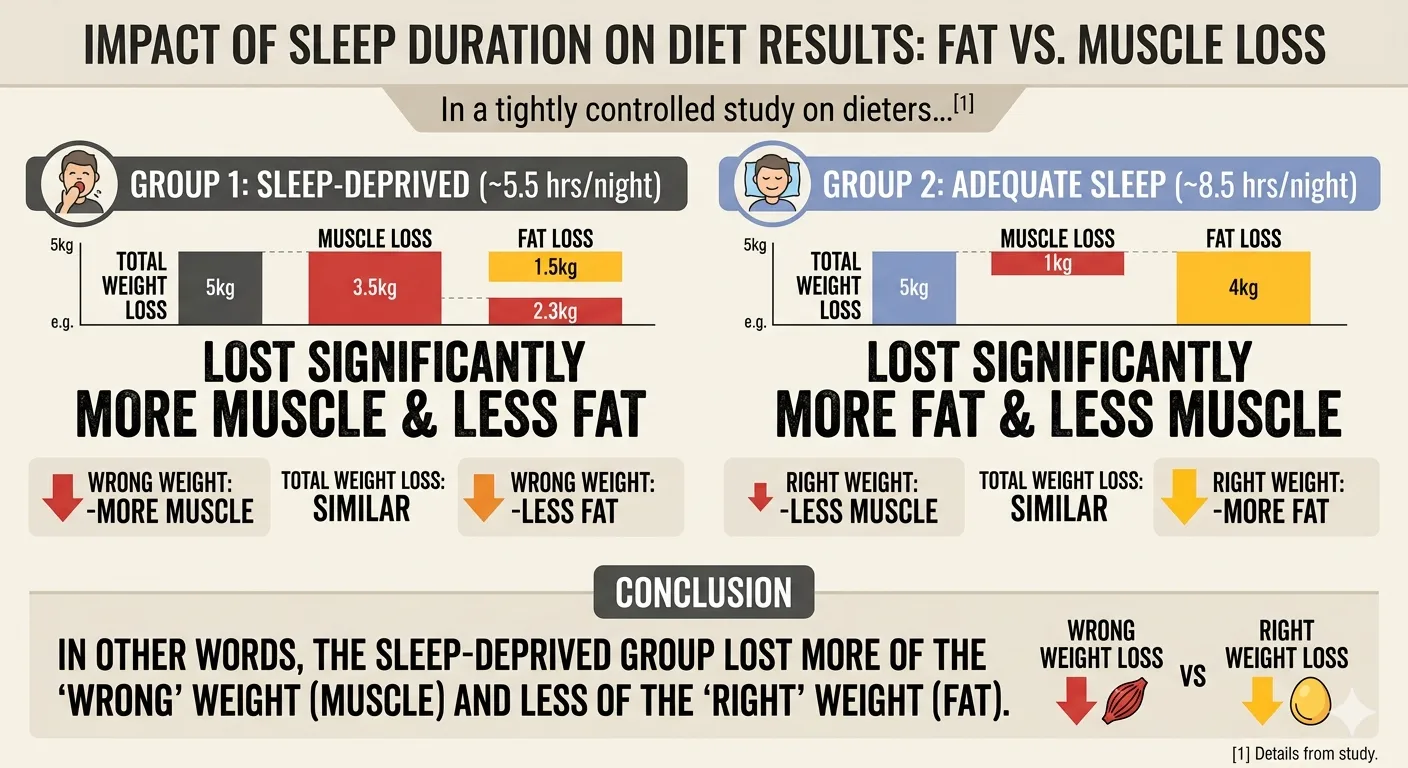
In a tightly controlled study, dieters who slept around 5.5 hours a night lost significantly less fat — and more muscle — than dieters on the same diet who slept closer to 8.5 hours, even though total weight loss was similar.[1] In other words, the sleep-deprived group lost more of the “wrong” weight (muscle) and less of the “right” weight (fat).
That distinction matters more than the number on the scale. Two people can lose the same five kilos and have completely different outcomes for their metabolism, energy, and how their clothes fit — depending on whether that weight came mostly from fat or from muscle. Muscle is metabolically active tissue; losing too much of it can make long-term fat management harder, not easier.
What I found most useful about this study is that it wasn’t measuring extreme sleep deprivation — 5.5 hours is what a lot of us would call “a normal busy week.” It didn’t require a crash diet or an all-nighter to see the effect. Just consistently shaving an hour or two off sleep, night after night, was enough to change how the body partitioned the weight it lost. That’s a low bar for sleep loss to clear — and a strong argument for treating sleep as part of the plan, not an afterthought to it.
Myth: “If My Diet and Workouts Are Solid, Sleep Doesn’t Matter Much”
This is the one I believed for years. I figured sleep was a “nice to have” — good for mood, maybe skin, but not something that actually moved the needle on fat loss. The research above tells a different story: sleep doesn’t just sit alongside diet and exercise, it actively shapes how effective they are.
Poor sleep increases hunger signalling, lowers the hormone that tells you you’re full, raises stress hormones that encourage fat storage around the middle, and shifts how your body divides up the weight it loses between fat and muscle.[1][2][3] You can be doing “everything right” on paper — tracking food, getting your steps in — and still be working against a tide of hormones that sleep would otherwise help keep calm.
This doesn’t mean sleep is the only thing that matters, or that one rough night undoes your progress (it doesn’t — your body is more resilient than that). But it does mean that if you’re putting real effort into your nutrition and movement and still feeling stuck, your sleep is worth a genuinely honest look before you assume something else is “wrong” with your approach. For a lot of us, it’s the missing piece we didn’t think to check.
Stress, Cortisol, and Why Belly Fat Feels So Stubborn
This is the part that finally made sense of my own “stress belly.” When sleep is short, cortisol — your body’s main stress hormone — tends to run higher in the evenings.[4] Cortisol’s job is to help you respond to short-term stress (think: the “fight or flight” hormone), but when it’s chronically elevated, it nudges your body to store more fat specifically around the abdomen.[4]
So you end up in a loop: poor sleep raises cortisol, raised cortisol encourages belly fat storage and increases appetite, and the stress of feeling stuck (plus the tiredness itself) makes it harder to wind down for good sleep the next night. It’s not that you’re doing anything wrong — it’s a feedback loop, and feedback loops need a deliberate interruption, not more effort thrown at the same routine.
The encouraging part: this loop runs in both directions. Cleveland Clinic notes that prioritising sleep is one of the most effective ways to bring cortisol back down,[4] alongside movement and time spent outdoors. That’s part of why my evening routine now leans toward calming things down rather than winding them up — including a small habit that’s become part of my wind-down: a few drops of pHix in my evening water. It’s stimulant-free, so it was never going to keep me wired before bed, and the gentle, “rest and digest” signal it’s designed to support fits naturally into that calmer part of my evening rather than fighting against it.
What My Evenings Used to Look Like (And What Changed)
I’m not going to pretend I’ve become a sleep saint with a 9pm bedtime and no screens — that’s not realistic for most of us, and it wasn’t realistic for me either. What changed was smaller and, honestly, a bit boring: I stopped treating my evening as “dead time” to cram things into.
For years, my evenings were when I’d finally get to emails, scroll through everything I’d missed, or squeeze in one more task because the day had gotten away from me. By the time I actually got into bed, my brain hadn’t had a single quiet moment — and then I’d lie there wondering why I couldn’t switch off. Poor sleep wasn’t really a “sleep problem.” It was a knock-on effect of how I was spending the two hours before bed.
The shift wasn’t dramatic. I started closing my laptop earlier, even if that just meant 30 minutes earlier than before. I noticed that on the nights I did that, I fell asleep faster and woke up less wired — and, over weeks, I felt less of that gnawing hunger in the evenings that used to send me to the kitchen for “just one more thing.” It wasn’t a switch flipping overnight (no fat-loss habit really is), but it was a clear, repeatable pattern once I started paying attention to it.
What Actually Helps: A Realistic Wind-Down Routine
None of this requires an overhaul. Small, consistent changes to your evening routine can support the hormone balance we talked about above. Here’s what I’ve found genuinely makes a difference — pick one or two to start with, rather than trying all of them at once:
- Set a “screens down” time, not just a bedtime. Even 30 minutes of no phone or laptop before bed gives your brain a chance to downshift before you’re lying in the dark trying to force it.
- Keep your room cool and dark. Your body’s internal clock responds strongly to light and temperature — a cooler, darker room supports the natural drop in body temperature that helps you fall asleep.
- Watch the evening caffeine, even “just one.” Caffeine can linger in your system for hours longer than you’d expect, quietly nudging your sleep quality down without you noticing.
- Move during the day, even briefly. A short walk, especially outdoors, has been linked to lower cortisol and better sleep that night.[4]
- Build a low-key wind-down ritual. Mine includes my evening water with pHix drops, a few minutes of just sitting rather than scrolling, and getting into bed slightly earlier than feels “necessary.” Small, repeatable, boring — and that’s exactly why it works.
The goal isn’t perfection. It’s giving your body’s overnight hormone system a fair chance to do its job, most nights, most weeks.
The Realistic Picture: Sleep Helps, But It’s Not the Whole Story
I want to be honest about something: better sleep isn’t going to undo a tough relationship with food, replace movement, or work like a switch that suddenly “fixes” fat loss. What the research actually shows is more modest — and more useful — than that. Sleep affects the hormones that govern hunger, fullness, stress, and how your body partitions the weight it loses.[1][2][3][4] Getting more of it doesn’t guarantee results, but it does mean the other things you’re doing — your meals, your movement, your consistency — have a better chance of actually working the way they’re supposed to.
For me, that reframe took the pressure off. I stopped seeing sleep as one more thing to optimise and started seeing it as the thing that makes everything else easier. Some weeks I get it right, some weeks life gets in the way — and that’s fine. The pattern over months is what matters, not any single night.
Before You Go
If any of this sounds familiar — doing “everything right” and still feeling stuck, or noticing you’re hungrier and more on edge after a bad night’s sleep — you’re not imagining it, and you’re not failing. It’s worth giving your evenings a little more attention, not as another task on the list, but as the quiet groundwork for everything else.
If you want to follow along as I keep figuring this stuff out in real life — including the messy, non-Instagram parts — join my email list below, or have a look at pHix if a stimulant-free addition to your evening routine sounds like something that might fit into yours. No pressure, no overnight promises. Just one more honest tool in the kit.

These statements have not been evaluated by the FDA. This product is not intended to diagnose, treat, cure, or prevent any disease. Always consult your healthcare provider before starting any new supplement.
References
- Nedeltcheva AV, et al. “Insufficient sleep undermines dietary efforts to reduce adiposity.” Annals of Internal Medicine, via NCBI PMC. https://www.ncbi.nlm.nih.gov/pmc/articles/PMC9031614/
- “Metabolic consequences of sleep and sleep loss.” NIH/PubMed Central. https://pmc.ncbi.nlm.nih.gov/articles/PMC4444051/
- “The Impact of Sleep Deprivation on Hunger-Related Hormones: A Meta-Analysis and Systematic Review.” MDPI, 2025. https://www.mdpi.com/2673-4168/5/2/48
- “Tips to Reduce Cortisol Levels and Dial Down Stress.” Cleveland Clinic. https://health.clevelandclinic.org/how-to-reduce-cortisol-and-turn-down-the-dial-on-stress