Book A Call Now

Why Stimulant-Free Fat Loss Actually Works Better
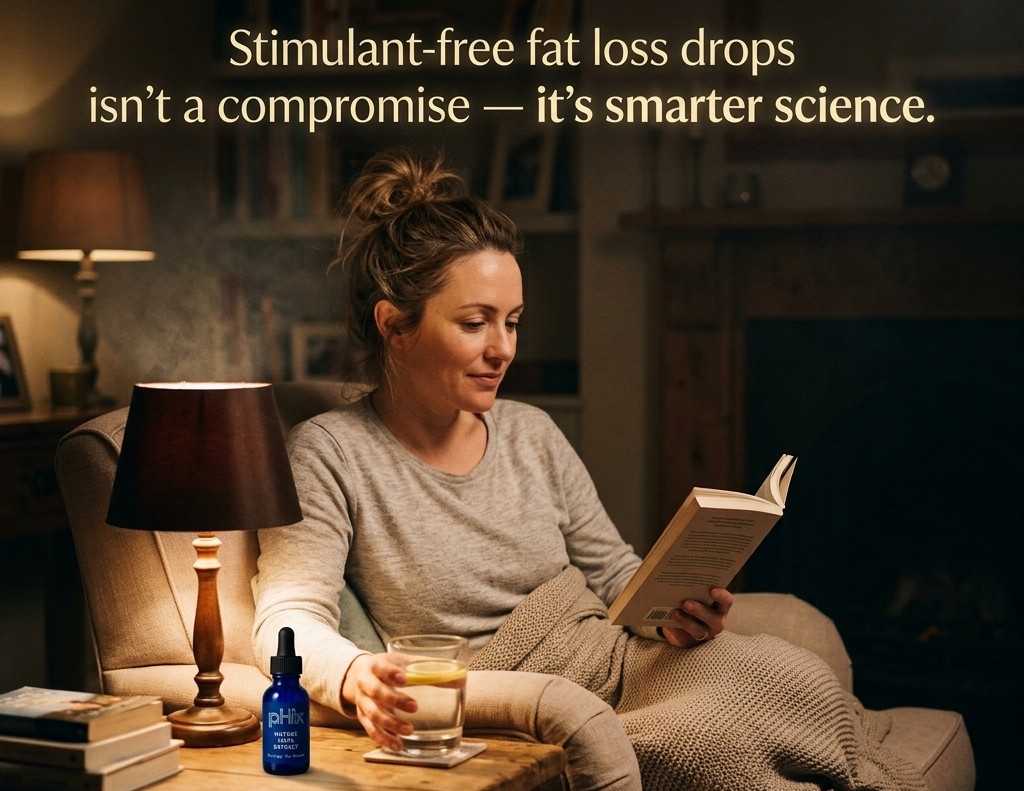
Stimulant-free fat loss isn't a compromise — it's smarter science. Here's what really happens in your body when you skip the caffeine jolt.
- On
- InpHix Drops, Weight Loss
A client of mine — I’ll call her Jen, though that’s not her real name — used to carry a tin of fat-burner capsules in her handbag like other people carry mints. Two before breakfast, a third if the afternoon looked rough. She told me the flutter in her chest twenty minutes later meant it was working. For a while, I believed her too. It turns out “wired” and “effective” aren’t the same thing at all — and the research on what stimulants actually do to your stress hormones explains exactly why she felt worse the harder she pushed. Watching her go through that cycle was what sent me down the research rabbit hole that became this post.
Jen’s Jittery Years
For the better part of a decade, Jen’s idea of “trying” to lose weight meant reaching for whatever had the most caffeine in it. Pre-workout powder, diet pills, the strongest coffee she could make. She told me she associated the jitters with progress — if she couldn’t feel her pulse in her ears, she assumed she wasn’t doing enough.
What she didn’t clock at the time was the pattern underneath it. She’d feel sharp for a couple of hours, then crash hard by early afternoon, reach for more caffeine to climb back out, and then lie awake at 11pm with her mind racing even though her body was exhausted. She’d wake up puffy and hungrier than the day before. She did this for years and quietly assumed that was just what “putting in the effort” felt like.
It wasn’t until we started digging into what stimulants do to the stress-response system that either of us understood why that cycle never actually got her anywhere. She wasn’t lacking willpower. She was running her nervous system in the wrong direction for what she was trying to achieve.
Looking back, she could point to specific weeks where she’d “done everything right” — logged her food, hit her step count, taken her capsules religiously — and still ended the week heavier and more exhausted than when she started. At the time she assumed she’d miscounted something, or that her metabolism was simply broken. Nobody had ever explained to her that the tool she was leaning on hardest might be the thing quietly undoing the rest of her effort.
What’s Actually Happening In Your Body
Here’s the plain-English version of what a stimulant does. Caffeine and similar compounds switch on your sympathetic nervous system — the “fight or flight” branch that’s meant to fire when you’re in danger, not when you’re trying to have a normal Tuesday. Part of that switch-on is a rise in cortisol, your body’s main stress hormone.[1]
A small amount of that is fine. The problem is that this effect compounds with everyday stress you’re already carrying — a stretch of caffeine most days measurably sharpens how strongly your body reacts to ordinary stressors, not just to the coffee itself.[2] So the “energy” isn’t coming from nowhere; it’s borrowed from a system that’s meant to be reserved for emergencies, and it adds up on top of whatever stress your day already has.
Chronically elevated cortisol does the opposite of what most people reaching for a fat burner actually want. It nudges your body toward storing fat rather than releasing it, and it can encourage your body to break down muscle for fuel instead of fat.[3] So the very tool marketed as a fat-loss shortcut can, over time, quietly work against the outcome you’re chasing — not because you’re doing it wrong, but because of how the stress-response system is wired.
(This is also why the timing of stimulants matters as much as the dose — more on that in a moment.)
This was the “huh, I had no idea” moment for Jen: the jitters she’d mistaken for progress were, physiologically, her body bracing for a threat that didn’t exist.
There’s a second layer to this that took both of us longer to piece together. Thermogenesis — a term that just means “generating heat by burning fuel” — is the actual process behind most fat-burning claims. Stimulants force a version of it through an adrenaline spike: quick, intense, and short-lived, followed by a crash once the spike passes. But your body has a second, quieter thermogenic pathway that doesn’t rely on adrenaline at all — brown fat tissue, which burns calories steadily over hours rather than in a single burst. You can support that slower pathway without ever touching your fight-or-flight system, which is the entire premise behind going stimulant-free rather than simply “less stimulated.”
The Myth: “If I Can’t Feel It, It’s Not Working”
This is probably the most common misconception in the fat-loss supplement world, and Jen believed it for years. We’ve been trained to associate a buzz with effectiveness. No jitters, no sweating, no racing heart — surely nothing is happening.
Real metabolic support doesn’t announce itself that loudly. Brown fat — a special type of fat tissue that burns calories to generate heat rather than storing energy — activates quietly in the background over hours, not in a single dramatic spike.[4] You’re not meant to feel a jolt. You’re meant to feel, if anything, steadier.
This is actually one of the reasons I use pHix as part of my own routine — it’s designed to support that quieter brown-fat pathway using a stimulant-free hop extract, without the caffeine hit. Some weeks I genuinely forget I’ve taken it that morning, and I’ve had to unlearn the instinct that “forgetting” means it isn’t doing anything. Subtlety isn’t the same as absence.
The Stat That Changed My Mind
I went looking for research on stimulant-free approaches specifically because I wanted to know if “gentler” also meant “weaker.” It doesn’t have to.
A six-week, placebo-controlled study out of the University of Guelph put a stimulant-free supplement head-to-head against a placebo in adults with obesity. The treatment group lost significantly more weight than the placebo group (roughly 2.3 kg versus essentially none), along with more body fat and a meaningfully smaller waist — and here’s the detail I found most reassuring: heart rate and blood pressure didn’t budge in either group.[5] No cardiovascular strain, no stimulant trade-off, just a measurable result.
Compare that with what caffeine-based thermogenics do to the body in the same window: measurable increases in blood pressure within the first few hours of taking them.[6] Both approaches can move the needle. Only one of them asks your cardiovascular system to work overtime to get there. That’s the trade-off nobody puts on the label.
What struck me most reading that study wasn’t the weight lost — 2.3 kg over six weeks is modest, and I’d never suggest otherwise. It was that the researchers were explicitly checking for the trade-off Jen had never once questioned during her own stimulant years: does this raise heart rate, does this raise blood pressure. Nobody had ever checked hers. She’d just assumed the flutter in her chest was the price of admission. It turns out that price was optional the entire time.
Why Sleep Is the Piece Everyone Skips
Here’s where the stimulant story loops back on itself in a way neither of us expected. Poor sleep raises cortisol the same way stimulants do — and stimulants, especially taken later in the day, are one of the most common reasons people sleep poorly in the first place.
When you’re short on sleep, your evening cortisol stays elevated instead of tapering off the way it should, ghrelin (the hormone that tells you you’re hungry) rises, and leptin (the one that tells you you’re full) drops.[3] Sleep-deprived research participants have consistently shown stronger cravings for high-sugar, high-fat foods and have eaten more of them.[7] So a stimulant that keeps you wired past dinner isn’t just costing you a good night’s sleep — it’s quietly working against fat loss the next day too, through appetite hormones you have zero conscious control over.
Jen used to treat sleep as the reward for a productive day, not as part of the actual work. Once she saw the hormone data, she understood why so many of her “disciplined” weeks went nowhere. She’d been sabotaging herself at 11pm and blaming herself at noon.
There’s something almost funny about it in hindsight: she’d take a stimulant specifically to power through a slump, that stimulant would keep her up past when her body wanted to sleep, the lost sleep would then raise her cortisol and hunger hormones the next day, and she’d reach for another stimulant to fight the resulting slump. It’s a closed loop, and the only way out of it is to stop feeding one end of it. Once she did, the whole cycle lost its grip within a couple of weeks — not because she found more willpower, but because she’d removed the thing generating the problem in the first place.
What Actually Helps (Without the Buzz)
None of this means overhauling your entire life overnight. It’s what I coached Jen toward once we’d figured out what was actually going on, and it’s what I still practice myself. The stimulant-free approach is less about restriction and more about not working against your own biology. A few things that make a real, sustained difference:
- Protecting the last few hours before bed — no caffeine after early afternoon, screens dimmed, room cool and dark.
- Eating enough protein at each meal so you’re not chasing energy dips with sugar or caffeine.
- Short walks after meals instead of intense sessions you can’t sustain — gentle, consistent movement beats sporadic burnout.
- A stimulant-free support like pHix, added to water or tea, as one small piece of the daily routine rather than a stand-in for the rest of it.
- Naming stress when it shows up — even just a few slow breaths before a hard conversation — since unmanaged stress adds directly to the cortisol load.
None of these are dramatic. That’s rather the point. Every one of them works quietly, in the background, the same way brown fat activation does — no spike, no crash, just a steady nudge in the right direction, repeated most days. If I’m honest, that was the hardest part for Jen to accept after years of chasing a buzz: that “boring and consistent” was doing more for her than “intense and occasional” ever had.
What Changed Once Jen Stopped Chasing the Buzz
The biggest shift wasn’t on the scale, at least not at first. Jen told me she stopped feeling like she was white-knuckling her way through every day. She slept properly for the first time in years. Her afternoons stopped having that 2pm cliff-edge feeling. She wasn’t lying awake doing mental laps at midnight.
The fat loss came, slowly and unevenly, the way real fat loss actually does. But the bigger win, she said, was getting her nervous system back on her side instead of treating it like an obstacle to override with more caffeine. I wish someone had told her that years earlier — that calm and consistent beats wired and depleted, every single time.
A Gentler Way Forward
If any of this sounds familiar — the tin of pills in the handbag, the 2pm crash, the wired-but-tired nights — you’re not doing anything wrong. You were probably just handed the wrong tool, the same as Jen was. Stimulant-free doesn’t mean passive; it means working with the systems your body already has, on a timeline that’s honest rather than dramatic. If you want to see what a stimulant-free routine with pHix looks like day to day, or you’d simply like more of this kind of research broken down in plain English, join my email list below — I send the stuff I wish more people had known years ago.
These statements have not been evaluated by the FDA. This product is not intended to diagnose, treat, cure, or prevent any disease. Always consult your healthcare provider before starting any new supplement.
References
- Lovallo, W.R. et al. “Cortisol Responses to Mental Stress, Exercise, and Meals Following Caffeine Intake in Men and Women.” PMC, National Institutes of Health. https://pmc.ncbi.nlm.nih.gov/articles/PMC2249754/
- “Habitual Caffeine Use Is Associated With Heightened Cortisol Reactivity to Lab-Based Stress in Two Samples.” PubMed, National Institutes of Health, 2024. https://pubmed.ncbi.nlm.nih.gov/39007443/
- “Sleep Deprivation: Effects on Weight Loss and Weight Loss Maintenance.” PMC, National Institutes of Health. https://pmc.ncbi.nlm.nih.gov/articles/PMC9031614/
- Matured hop extract (MHE3) brown fat / thermogenesis mechanism research. PMC, National Institutes of Health. https://pmc.ncbi.nlm.nih.gov/articles/PMC4784395/
- Woodgate, D.E. & Conquer, J.A. “Effects of a Stimulant-Free Dietary Supplement on Body Weight and Fat Loss in Obese Adults: A Six-Week Exploratory Study.” Current Therapeutic Research, 2003. PMC, National Institutes of Health. https://pmc.ncbi.nlm.nih.gov/articles/PMC4052995/
- “The Acute Effects of a Commercially Available Caffeinated and Caffeine-Free Thermogenic Dietary Supplement on Resting Energy Expenditure, Hunger, and Hemodynamic Responses.” Journal of Functional Morphology and Kinesiology (MDPI). https://www.mdpi.com/1661-3821/4/1/6
- “Increased Hunger, Food Cravings, Food Reward, and Portion Size Selection after Sleep Curtailment in Women Without Obesity.” PMC, National Institutes of Health. https://www.ncbi.nlm.nih.gov/pmc/articles/PMC6470707/