Book A Call Now

Vagus Nerve and Weight Loss: An Unexpected Link
Your vagus nerve quietly shapes appetite, stress, and metabolism. Here's the surprising gut-brain science behind fat loss — and what helps.
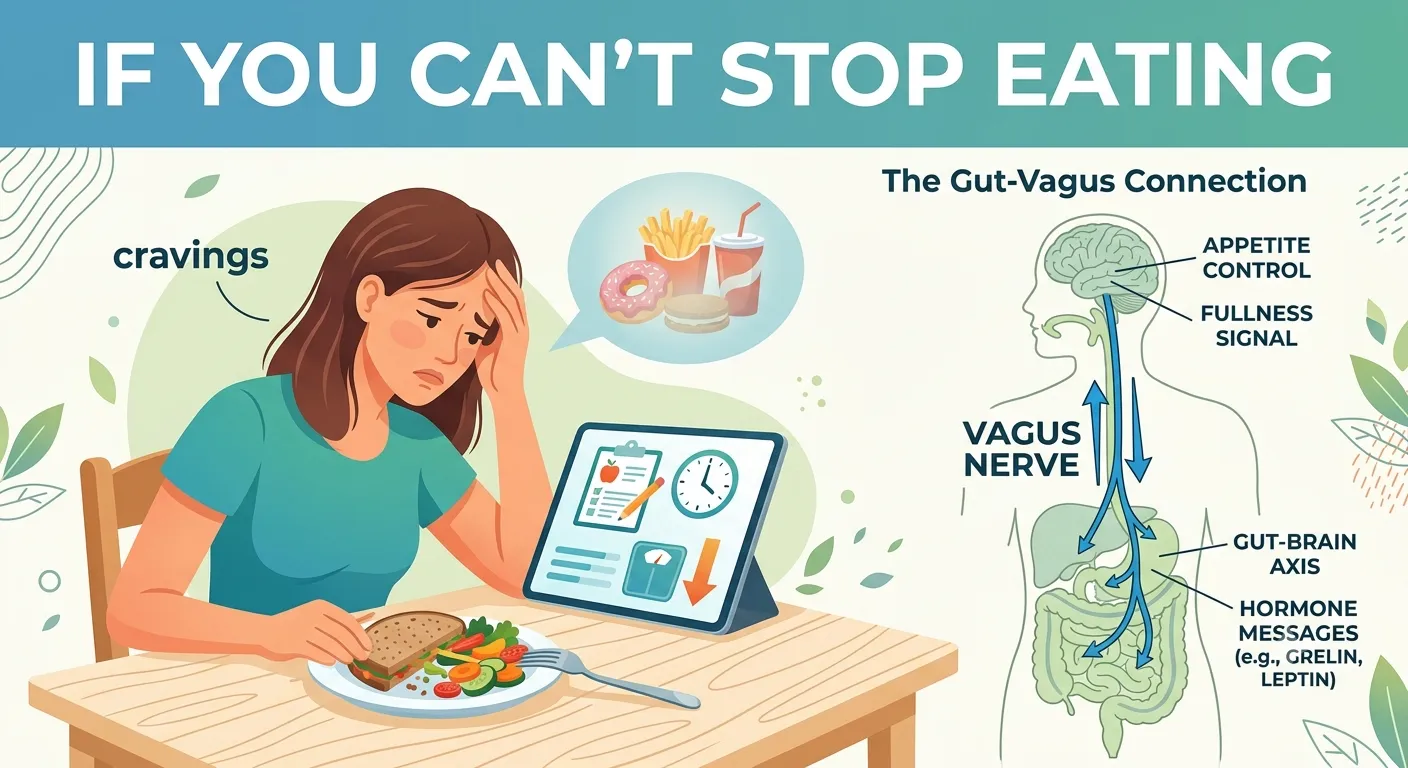
I used to think “gut feeling” was just an expression. Then I came across something that stopped me mid-scroll: roughly 80 to 90% of the traffic on your vagus nerve runs from your gut up to your brain, not the other way around.[1] Your stomach is, quite literally, sending more messages to your brain than your brain sends back. I learned this during a stretch last year when stress had me eating standing at the kitchen counter, not really tasting anything, just trying to make a tight feeling in my chest go away. It turns out that tight feeling and the mindless eating were running through the exact same nerve. Once I understood that, a few things about my own patterns finally clicked into place.
What Even Is the Vagus Nerve?
Here’s the plain-English version, because I had to look this up more than once before it stuck. The vagus nerve is the longest of your twelve cranial nerves — the ones that connect your brain directly to the rest of your body. It starts at the base of your brain, runs down through your neck and chest, and ends down in your gut. Think of it as a two-way phone line between your head and your digestive system, except about nine out of ten calls are coming from the gut’s end of the line.[1]
This nerve is the main highway of what’s called your parasympathetic nervous system — the “rest and digest” mode that sits opposite your “fight or flight” response. When it’s firing well, your heart rate settles, your digestion works properly, and your body can shift energy toward repair instead of staying braced for a threat that isn’t actually there.
Researchers talk about “vagal tone” — basically, how responsive and flexible this nerve is. Higher vagal tone tends to track with better stress recovery, steadier digestion, and even healthier inflammation levels.[1] Lower vagal tone shows up alongside chronic stress, disrupted eating patterns, and — this is the part that surprised me — a harder time recognizing when you’re actually full. That single fact reframed a lot of my own history with food.
The Study That Surprised Me
I went looking for actual research before writing this, because “vagus nerve” gets thrown around a lot in wellness content without much behind it. What I found was more substantial than I expected. A systematic review and meta-analysis published in the International Journal of Obesity in August 2025 pulled together every rat, minipig, and human study on vagus nerve stimulation and metabolism going back to 1966 — 529 papers screened down to 15 that met their bar for inclusion.[2]
The pattern across species was consistent: stimulating the vagus nerve reduced weight gain in animal models, lowered appetite significantly in rats, and shifted energy expenditure in a favorable direction. The four human randomized controlled trials in the review also showed a measurable effect on weight, though the researchers were upfront that the human data is still thinner than the animal data, and effects on human energy expenditure couldn’t be reliably estimated yet.[2]
A quick caveat that matters: most of this research used implanted electrical devices, similar to ones the FDA has approved for epilepsy and depression, not something you take or drink. So this isn’t “proof a supplement melts fat” — it’s evidence that this particular nerve is genuinely wired into appetite and metabolism, which is a different and more interesting claim. It’s also why researchers are now actively exploring gentler, non-invasive ways to engage the same pathway, including taste-based and breath-based approaches.[2] That’s the thread I find most useful for everyday life, and it’s the one we’ll pull on for the rest of this post.
Myth: “If You Can’t Stop Eating, It’s a Discipline Problem”
I believed this one for years, and I think a lot of us still do. The story goes: if you keep eating past full, you simply lack willpower. But a 2021 study published in Scientific Reports found something that complicates that story considerably.[3] Researchers showed that diets high in fat or sugar actually blunt the vagus nerve’s ability to send “I’m full” signals from a stretched stomach to the brain. After sustained exposure to these diets, it took a substantially larger amount of stomach distension to trigger the same fullness signal that used to register much earlier.[3]
In other words, the wiring itself adapts — and not in a helpful direction. It’s not that the person eating past full lost their discipline one day. It’s that months or years of a certain way of eating recalibrated the actual nerve responsible for telling them when to stop. The “just eat less” advice misses this entirely, because it assumes the signal is intact and the only missing ingredient is resolve.
The encouraging flip side, which several researchers in this space point to, is that this recalibration seems to run in both directions. Nerves that have been desensitised by years of a particular diet pattern can become more responsive again with sustained changes — it’s not a one-way door. That reframing alone took a lot of unearned guilt off the table for me.
My Own Vagus Nerve Wake-Up Call
The stress-eating stretch I mentioned earlier happened during a genuinely hard few months — the kind where you’re running on adrenaline and convincing yourself you’re “fine” because you’re still getting things done. I wasn’t binge eating in any dramatic sense. I was just never quite landing in my body. Meals were something I did while thinking about six other things, and I’d often finish a plate without registering that I’d eaten at all.
When I started learning about the vagus nerve, the pattern made more sense. Chronic stress keeps your sympathetic nervous system — the “go, go, go” half — running the show, which crowds out the vagus nerve’s calmer signals, including the ones telling you that you’re satisfied. I started building in small things that nudged me back toward “rest and digest”: a few slow breaths before meals, actually sitting down to eat, a short walk after dinner instead of scrolling on the couch. Around the same time, I’d started using pHix as part of my evening routine, mostly for the stimulant-free metabolism support, and I noticed I was sleeping a bit easier too — which tracks with how this whole gut-brain system is supposed to work together rather than in separate lanes.
None of it was a single fix. It was more like several small adjustments pointed in the same direction, and the direction mattered more than any one piece.
The Bitter Connection: How Taste Talks to Your Gut
Here’s the part of the research that genuinely surprised me. Your gut lining has its own taste receptors — yes, in your intestines, not just your tongue — and they respond specifically to bitter compounds.[4] When those receptors get activated, they trigger the release of GLP-1, a hormone that slows digestion and signals satiety, and that signal travels to your brain largely via the vagus nerve.[4]
This is part of why bitter foods — leafy greens, coffee, bitter melon, hops — have shown up again and again in traditional eating patterns around the world, often before or alongside meals. It’s not just tradition for tradition’s sake; there’s a plausible mechanism behind it. Hop extract specifically has been studied for this bitter-receptor pathway, which is part of why it’s the core ingredient in pHix — it’s designed to engage that same gut-to-brain bitter signalling rather than relying on caffeine or other stimulants to force a metabolic response.
I want to be careful here, because this is exactly the kind of finding that’s easy to oversell. The research on bitter taste receptors and GLP-1 is real and growing, but it doesn’t mean any bitter substance is a guaranteed fat-loss switch. What it does mean is that the gut-brain conversation is more sophisticated than “calories in, calories out,” and taste itself is part of the signalling — which is a genuinely interesting plain-English mechanism worth knowing, whether or not you ever try a hop-based product.
What Actually Helps: Toning Your Vagus Nerve Naturally
The research on natural, non-invasive ways to support vagal tone is more mature than I expected, and a lot of it comes down to things you can start tonight without buying anything. Cedars-Sinai’s health team summarised several approaches backed by current research[5]:
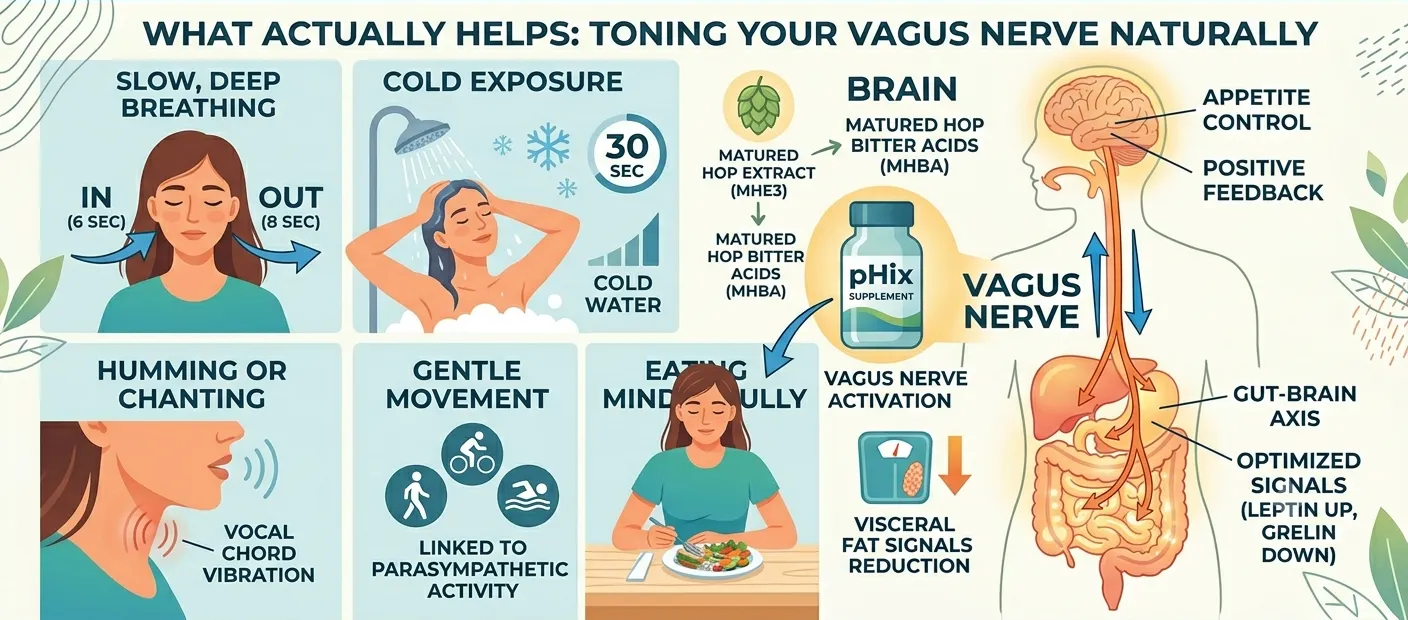
- Slow, deep breathing — in through your nose for a count of six, out through your mouth for a count of eight. A few minutes is enough to shift things measurably.
- Cold exposure — finishing a shower with 30 seconds of cold water, working up gradually, taps into a reflex that calms heart rate and engages the vagus nerve directly.
- Humming or chanting — the vibration of your vocal cords runs right past a branch of the vagus nerve in your throat.
- Gentle movement — endurance activities like walking, cycling, or swimming are linked to better parasympathetic activity over time.
- Eating slowly, without screens — giving your gut’s signals time to actually reach your brain before the plate is empty.
- pHix supplement – made from matured hop extract (MHE3), which contains matured hop bitter acids (MHBA) – supports visceral fat reduction, metabolism, and overall wellness by activating the vagus nerve
None of these require special equipment or a big time commitment. The common thread is simply giving your body’s calmer half a chance to do its job, instead of staying in a low-grade “go” state all day and wondering why fullness signals feel muted.
What’s next
If there’s one thing I’d want you to take from all this, it’s that fat loss isn’t purely a matter of willpower or the right product — your nervous system is genuinely part of the equation, and it’s a part you can actually influence. I’m still learning my own vagus nerve’s habits, honestly. Some days the breathing exercises feel like a chore and I skip them, and that’s fine too. This is a long game, not a sprint.
If you want a stimulant-free way to support your metabolism while you work on the bigger picture — sleep, stress, slowing down at meals — pHix has been a steady, quiet part of my own routine, and you’re welcome to read more about how it works on the Trienics site. And if you’d rather just follow along as I keep figuring this out in real time, my email list is the place I share the stuff that doesn’t make it into a polished post.
Disclaimer: These statements have not been evaluated by the FDA. This product is not intended to diagnose, treat, cure, or prevent any disease. Always consult your healthcare provider before starting any new supplement.
References
- Yiyang Wang et al., “Gut-brain communication and obesity: understanding functions of the vagus nerve,” Journal of Clinical Investigation, 2021. https://www.jci.org/articles/view/143770
- Tianxiao Shen et al., “Effect of vagus nerve stimulation on metabolism: a systematic review and meta-analysis,” International Journal of Obesity, vol. 49, 2383–2394 (2025). https://www.nature.com/articles/s41366-025-01871-w
- “Both high fat and high carbohydrate diets impair vagus nerve signalling of satiety,” Scientific Reports, 2021. https://www.nature.com/articles/s41598-021-89465-0
- “Metabolic control via nutrient-sensing mechanisms: role of taste receptors and the gut-brain neuroendocrine axis,” American Journal of Physiology-Endocrinology and Metabolism, 2019. https://journals.physiology.org/doi/full/10.1152/ajpendo.00036.2019
- Amy Paturel, “Bolster Your Brain by Stimulating the Vagus Nerve,” Cedars-Sinai, March 2024. https://www.cedars-sinai.org/stories-and-insights/healthy-living/stimulating-the-vagus-nerve